Guides / AI ·
Is using AI in Ableton cheating?
Copilot, LIA and Feater can now drive your session by conversation. Where the line actually sits between a tool that does the work and a tool that decides what the work is, plus the one job I genuinely hand over.
First, a correction to something almost everyone gets wrong, including the headlines: Ableton has not put AI in Live.
The tools people mean are all third party. Ableton Copilot is an open source MCP server built on ableton-js that lets an AI assistant drive Live directly: creating tracks, editing MIDI, managing devices. LIA is a commercial assistant that connects to Live and takes instructions in plain language, and it is explicit that it does not generate music, it acts on your session. Feater sits in the same category, tidying projects, building sequences and arranging. Others target the master bus, building a chain and hitting a loudness figure.
That distinction matters. Nothing here is baked into the software you already own, and none of it is coming for you unless you go and install it.
The question is wrong
“Is it cheating” assumes a rule and a referee. There is neither. Nobody is checking, and the audience cannot tell.
What people are actually asking is: will this stop me becoming good? That is a much better question, and it has a real answer.
Every tool in this genre was called cheating at some point. Drum machines were cheating because you were not a drummer. Quantise was cheating because you could not play in time. Presets were cheating because you had not done the sound design. Sidechain plugins were cheating because a compressor and a ghost kick was the proper way.
I use Kickstart on almost everything, and it exists purely so you do not have to set up sidechain compression by hand. Nobody has ever called that cheating, because the argument is never really about the tool. It is about how recently the tool arrived.
The line that actually matters
Not human versus machine. It is this:
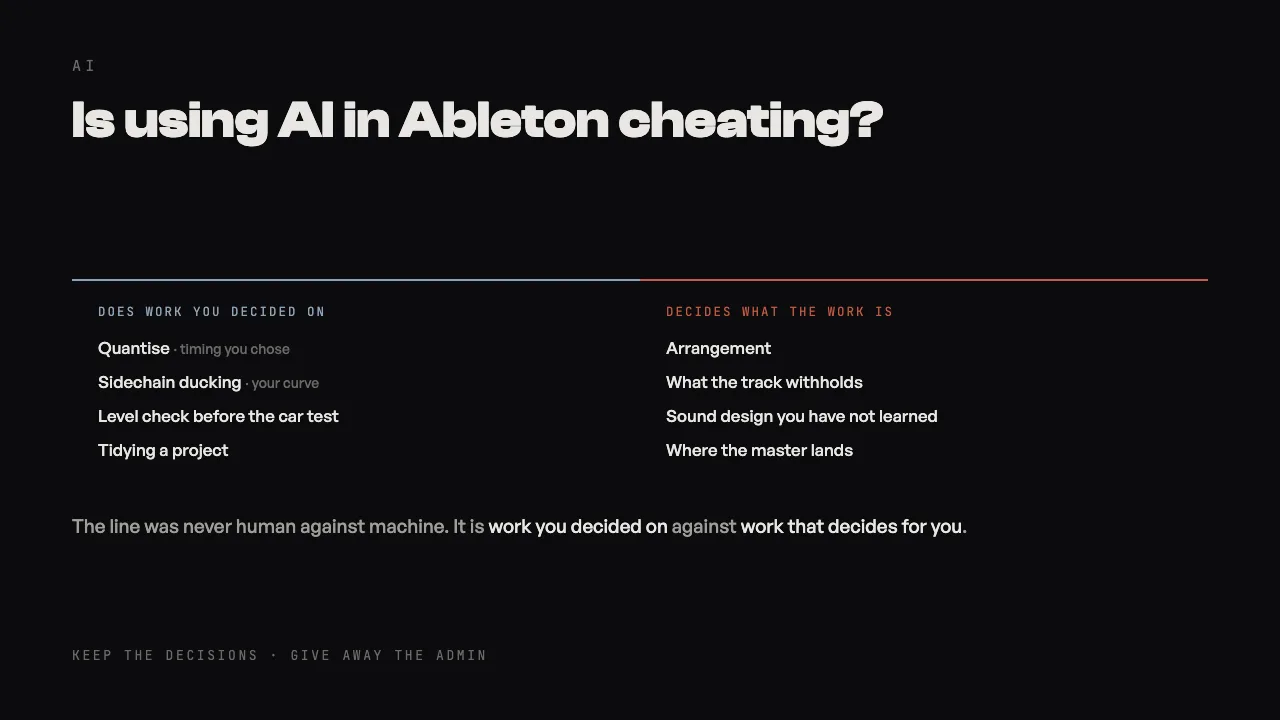
Does the tool do work you have decided on, or does it decide what the work is?
A limiter does work you decided on. Quantise does work you decided on. Kickstart does work you decided on, at a curve and a cutoff you chose, for a groove you wrote.
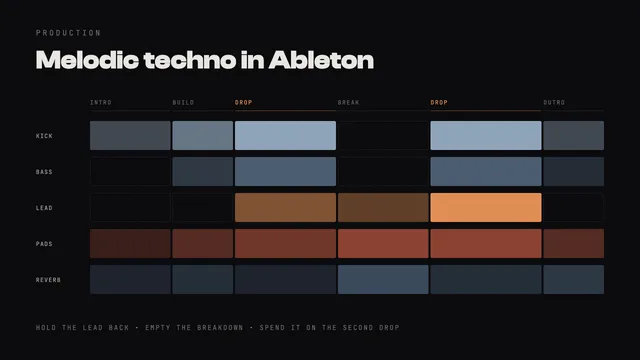
An assistant that arranges your track has decided what the work is. Not badly, necessarily. But the arrangement is the part where you decide what the record withholds and when it finally gives, and I argued in the production guide that arrangement is the hard part and the part that separates a loop from a record. Hand that over and you have handed over the thing.
The same test cuts the other way and clears a lot of tools instantly. Something that finds every unnamed track and tidies your project is not making a single musical decision. Neither is something that scans for clipping. That is admin, and you are not a better producer for doing admin slowly.
The job I do hand over
I use an AI assistant to check mastering levels on a quick bounce.
That is it, and it is worth being precise about why, because it is not a creative act. When a mix is roughly there I want a fast readout of where the levels sit before I take it out to the car, which is still the most honest listening test I have. Car speakers are unforgiving, the road adds noise, and problems that hid behind studio monitors turn up in the first ten seconds.
Getting a level check in seconds rather than breaking flow to open a metering plugin and squint at it means I do the car test more often. Doing it more often is the actual benefit.
And I should be honest: you do not need AI for this. A loudness meter has done the job for years, and Live’s own metering will tell you most of what you need. The assistant is a convenience, not a capability. Anyone telling you these tools unlock something otherwise impossible in mastering is selling something.
What I will not do is let it decide the master. Loudness is a judgement about how the record should feel, not a number to hit, and a tool aiming at a target figure will happily squash the life out of a track that was supposed to breathe.
Where it genuinely costs you
One real risk, and it is not moral.
Sound design is how you build ears. The reason I know what a filter envelope at 200 milliseconds does is that I have set that envelope a few thousand times and heard the result. If an assistant sets it for you every time, you never build the association, and you will not notice the gap until you are somewhere it cannot help you: a collaboration, a studio that is not yours, a moment where you need to know what is wrong by listening.
That is not cheating. It is just a slower path to competence disguised as a faster one.
So the rule I would offer, if you want one: use it for the parts you already understand, not the parts you are still learning. Tidying a project you know how to tidy is free. Skipping the sound design you have not learned yet is a loan against your own ears.
The short version
It is not cheating. Nobody is marking your homework, and the finished record is the only thing anybody hears.
But the tools that hold their value are the ones that do work you decided on, and the ones worth being wary of are the ones that decide. Keep the decisions. Give away the admin. Do the car test more often than you think you need to.
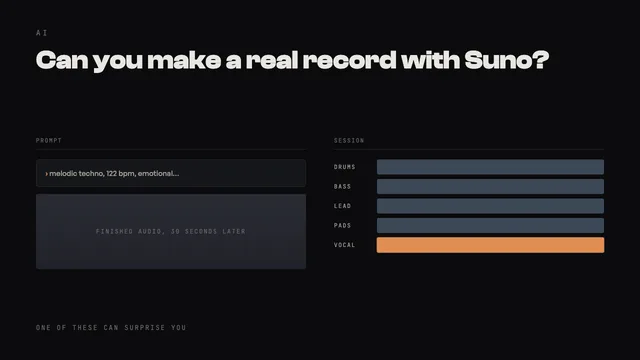
If the question you actually have is about generating music from scratch rather than assisting in your session, that is a different argument and I have written it separately: can you make a real record with Suno.