Guides / DJing ·
What melodic techno DJs can steal from James Hype
He is a tech house DJ, not a melodic techno one, and mixes at roughly the opposite speed to us. That is exactly why his cue, loop and EQ work is worth studying, and here is which parts of it survive at 122 BPM.
I make melodic techno. Long blends, harmonic mixing, tension held for two minutes before anything resolves. I have written a whole guide about it.
James Hype plays a different genre entirely. He is a tech house, house and bass house DJ, and he curates his own selections under exactly that description. His records mostly sit around 130 to 135 BPM, against the 122 to 126 most melodic techno lives at, and his sets are built on rapid transitions, live mashups and routines across multiple decks.
So this is not a melodic techno DJ, and I am not claiming he is one. On paper there is nothing in his approach for someone mixing a seven minute record at 122 BPM.
I still think he is one of the most useful DJs to watch if you play our genre, and the reason is that the mechanics and the pacing are separable. You can take one without the other.
The four decks are not the point
The easy read on his sets is “four CDJs, unreachable”. He has been clear himself that the techniques are not tied to the gear, and demonstrates them on ordinary controllers with workarounds where a feature is missing.
That matters because it moves the whole thing from equipment to intent. The question stops being “how many decks do I need” and becomes “do I know exactly what is happening in the next sixteen bars, on every channel”. Most of us do not. That is the actual gap, and it has nothing to do with hardware.
Hot cues as an instrument, not a safety net
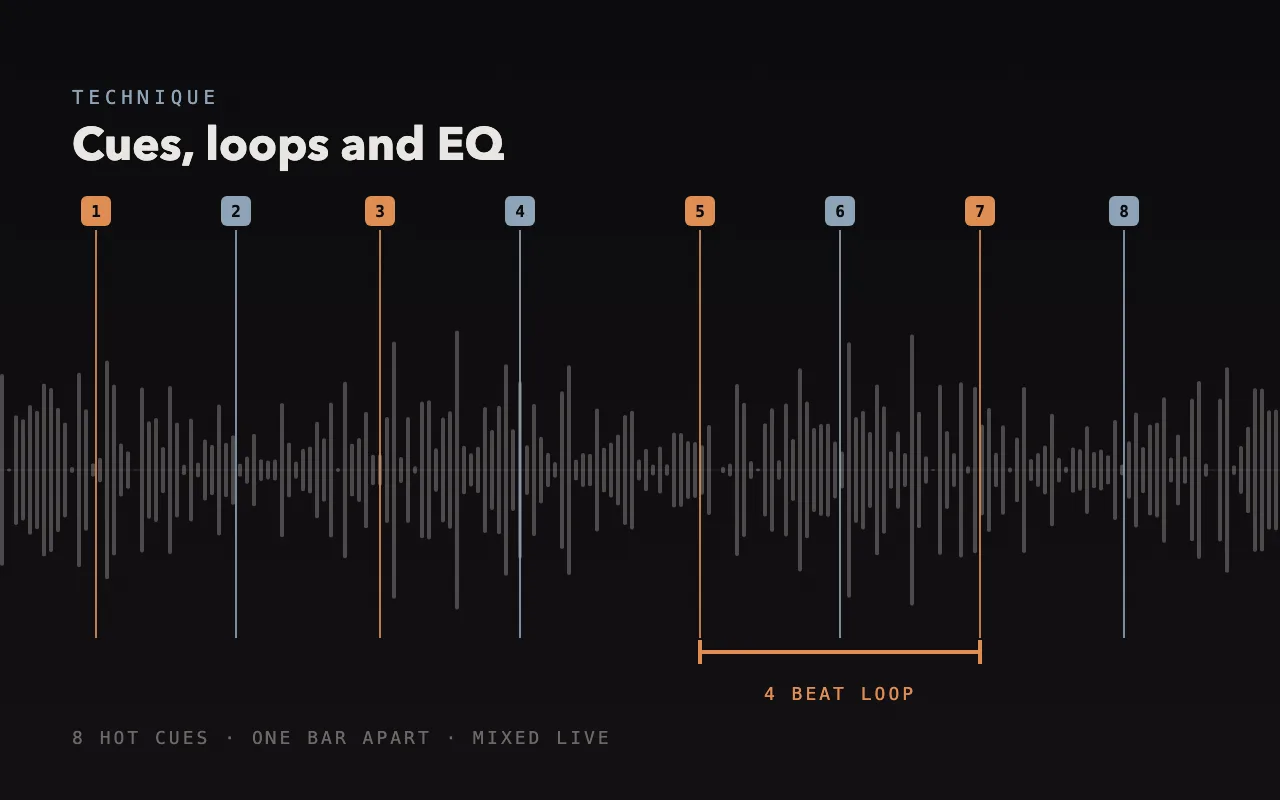
Most of us set one cue at the first kick and never touch the pads again. In his playing, the pads are how the performance happens: cues laid across a track so sections can be triggered, reordered and stacked live.
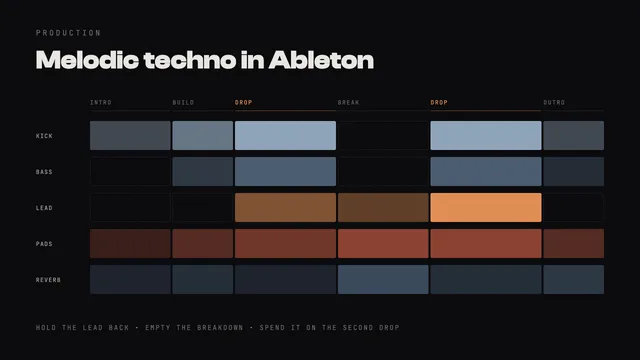
This is the piece that transfers straight into melodic techno, even though nothing about the speed does. Melodic techno tracks are architectural. There is a breakdown, a build, a drop, a second breakdown, an outro. Cue those sections and you stop being at the mercy of the arrangement. If the breakdown is running long and the floor is going with you, jump the build. If the energy sags, skip a section rather than riding it out.
Try this: take a track you know, drop cues on every structural change instead of just the intro, and play it out. You will find yourself making decisions you never had access to before.
Loops are a tempo control, not a rescue
The loop button gets treated as an emergency brake, something you hit when a mix is going wrong. At tech house tempos it becomes a rhythmic device, used deliberately, in bar-accurate lengths.
In melodic techno the same tool solves a different problem. Our intros are long and our outros are longer, and sometimes the record you want next needs eight more bars of runway than the one playing is going to give you. A four or eight bar loop at the tail of an outro buys you that time without anyone noticing, and it lets you hold a breakdown until the two tracks line up harmonically. It is the difference between mixing on the track’s schedule and mixing on yours.
EQ is the performance
The one thing his style and ours genuinely share. Neither is about the crossfader. Both are about deciding, band by band, which record owns the low end at any given moment and moving that ownership across without a gap or a pile-up.
The difference is the clock. He does it in a bar. In melodic techno you might spend ninety seconds on the same handoff, walking the bass across so gradually that nobody can name the moment it changed. Same skill, different tempo of decision.
What does not transfer
Be honest about this or you will ruin a set. Melodic techno does not want to be cut every sixteen bars. The genre works because tension is allowed to build, and chopping it up to look busy destroys the thing people came for. Anyma and Afterlife sets are not impressive because a lot is happening. They are impressive because so little is happening, for so long, and then it does.
So take the mechanics: the cue discipline, the loop as a decision, the EQ as a performance. Leave the pacing. Use the technique to hold tension rather than to break it.
Learn it from the source
I am a producer who mixes, not a touring DJ, so I would rather point you at the people who do this for a living than pretend otherwise. James Hype has broken his own approach down at length in the How I DJ series with DJ Mag and Pioneer DJ, covering four deck mixing, cues, looping and EQ, and there is a full course through Digital DJ Tips if you want the long version. Watch his hands rather than the tracklist.
Then practise on something slow
Technique needs material. My tracks are built with proper intro and outro runways precisely so there is room to work: Northern Soulmates at 122 BPM in Gb Minor for harmonic practice, Other Side at 128 in B Minor for long atmospheric transitions, and Chain Reaction at 127 in G Minor when you want something with more weight to cut against.
Set eight cues on one of them tonight. Not one at the start. Eight.