Plugins / Instrument (MIDI generator) ·
Lantern: a counter melody plugin that writes the top line above your lead
Give Lantern your lead and it writes the companion part an octave or two above: answering in the gaps, moving against it, holding chord tones or sparkling on the off-beats. The bright top line that makes a melodic house lead feel finished.
- Plugin
- ORIKLE Lantern
- Type
- Instrument (MIDI generator)
- Formats
- AU, VST3, Mac
- Version
- 0.1
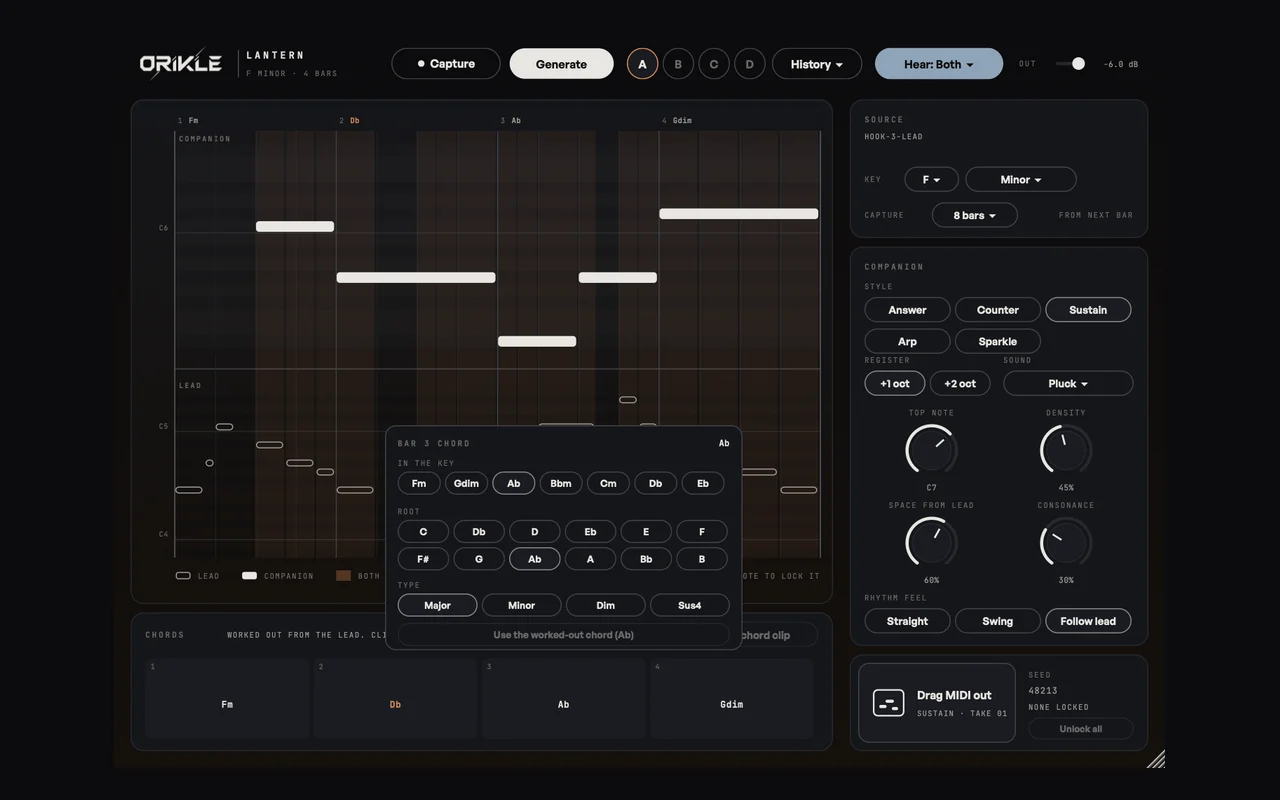
In the old stories, a lantern guides lost souls through the dark. In melodic house, it is that thin, bright line floating above the lead that makes the whole thing glow. Same job, really.
Why I built it
I kept finishing leads that sounded right on their own and slightly empty in the mix. Listen closely to the records I love in this genre and there is nearly always something up there: a pluck answering the lead in its gaps, a held note shimmering over the chord change, an arp twinkling on the off-beats.
Writing that part is surprisingly hard. Double the lead an octave up and it sounds cheap. Write something independent and it fights the lead for attention. The good ones are in conversation with the lead: they speak when it breathes, and they get out of the way when it sings.
I wanted a part-writer that knows the rules of that conversation.
What it does
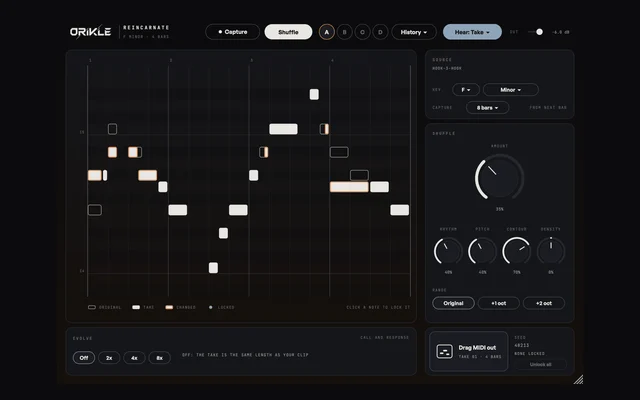
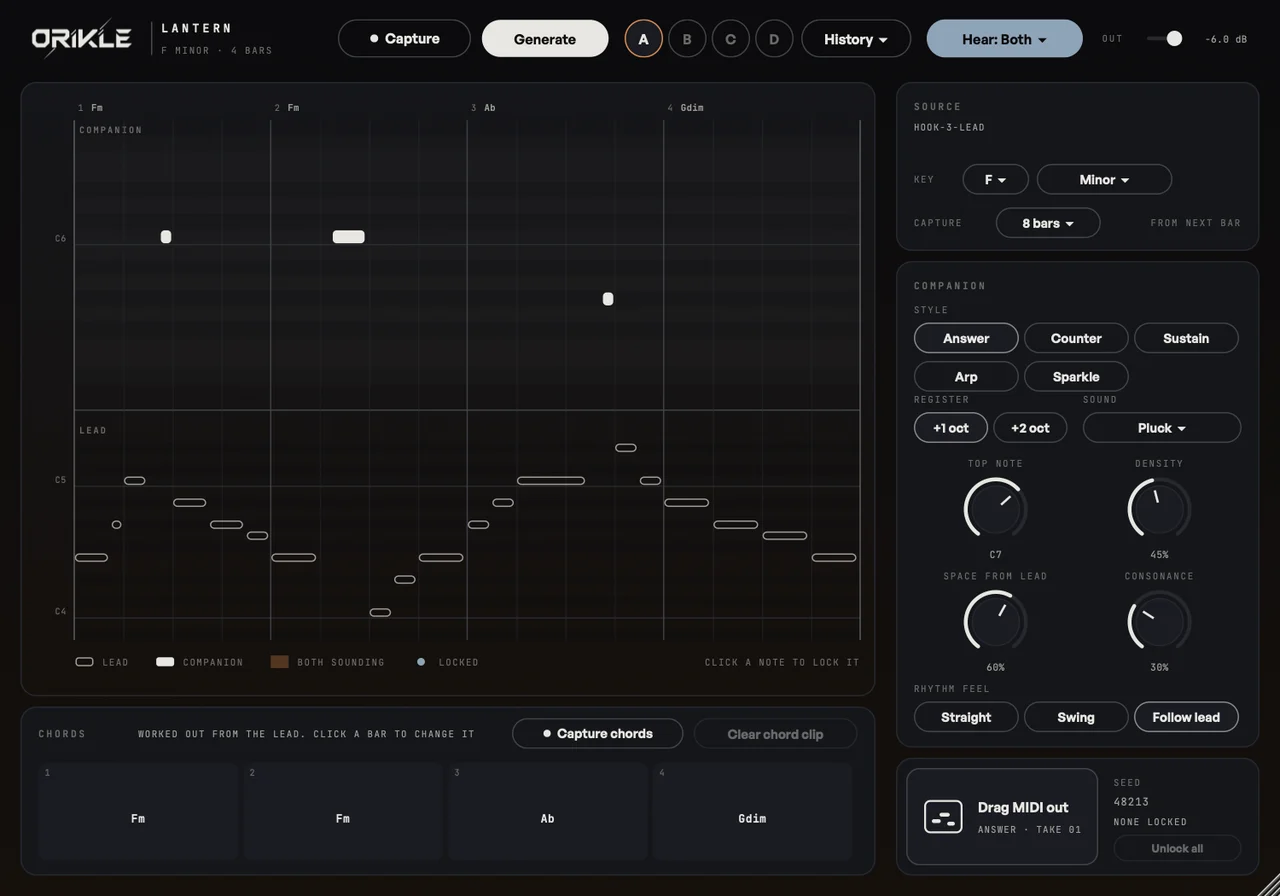
Capture your lead (or drop in a .mid), and Lantern reads the key and works out a chord for every bar. Click any bar to pick another chord, or give it your real chord clip for exact harmony.
Then pick a style and press Generate:
- Answer: short replies in the lead’s rests. Call and response.
- Counter: moves the other way to the lead.
- Sustain: long chord tones held above it.
- Arp: the bar’s chord broken up in the high register.
- Sparkle: sparse plucks on the off-beats.
Shape it with Register (+1 or +2 octaves), Top note, Density, Space from lead, Consonance (chord tones only, up to 7ths, 9ths and 11ths) and Rhythm feel (straight, swung, or following the push of your lead).
The rules it keeps
This is the part I care about most. Against the lead’s melody, Lantern never plays a unison, never doubles at the octave, never plays a minor second, and always sits at least 3 semitones above. Strong beats lean to chord tones, steps stay small, and Answer only ever speaks in the rests. Against a chordal lead (stabs), it relaxes and only avoids the harsh minor seconds.
Those rules are why it sounds like a second musician and not a second MIDI file.
The benefits
- Finishes a lead in minutes. The “something is missing up top” problem, solved without a week of trial and error.
- No clashes, by design. The rules mean you can trust every take before you even listen.
- Hear both together, in time. Preview the companion as a pluck, a pad or a saw against the lead, synced to Ableton.
- Four slots, history and note locks, so you can keep the three notes you love and regenerate the rest.
- Drag MIDI out onto a track with your brightest synth.
How I use it on a track
Answer style for the verse, so the top line talks to the lead without crowding it. Sustain for the breakdown, so a held note glows over the chord change. Sparkle for the last drop, quietly, on a bell-like pluck with lots of delay. Three parts, one lead, and the mix finally feels lit.
The honest bit
It writes companions, not leads. Give it a weak lead and it will very politely accompany a weak lead. And it will never be as clever as the producer who wrote the part you are thinking of, but it is a lot quicker than becoming that producer.
Questions about Lantern
+ What does ORIKLE Lantern do?
It writes a companion part above your lead line, an octave or two up, that complements the lead instead of doubling it. Five styles: Answer (replies in the lead's rests), Counter (moves against it), Sustain (held chord tones above it), Arp (the chord broken up high) and Sparkle (sparse high plucks on the off-beats). The part drags out as MIDI.
+ Does it know my chords?
It works out a chord for every bar from the lead and shows them in a strip you can click to change. For exact harmony, capture or drop in your chord clip and it follows that instead.
+ Will it clash with my lead?
It keeps strict rules against the melody: no unisons, no octave doubling, no minor seconds, and it always sits at least 3 semitones above. Every note stays in the key and under a top note you set, so it never gets shrill.
+ Can I buy Lantern?
Not yet. I built it for my own records. DM the word LANTERN to @orikle_music on Instagram if you want to know more or try it.