Plugins / Audio effect (vocal EQ) ·
Vocal Doctor: the vocal EQ plugin that tells you what's wrong
I was tired of sweeping an EQ around a vocal and hoping. So I built a vocal EQ for Ableton that listens first, names the problem (boom, box, harsh esses, no air), suggests the fix and lets me hear it at matched loudness.
- Plugin
- ORIKLE Vocal Doctor
- Type
- Audio effect (vocal EQ)
- Formats
- AU, VST3, Mac
- Version
- 0.1
Every vocal I work on has the same three or four problems. The trouble is they never sit at the same frequency twice, and finding them by ear at 1am is how you end up boosting the thing you meant to cut.
So the first plugin I ever built was a doctor. You bring it the patient, it listens, and it tells you what hurts.
Why I built it
The vocal is the emotional centre of my melodic records. A track like Northern Soulmates lives or dies on whether the voice sits on top of the pads without poking you in the ear. I found I was spending more time hunting for problems than making decisions about them.
The classic routine goes like this. Grab a narrow bell, boost it 10 dB, sweep it around until something sounds horrible, cut there. It works, but it is slow, it lies to you because louder always sounds “different”, and by the fourth sweep your ears have given up the ghost.
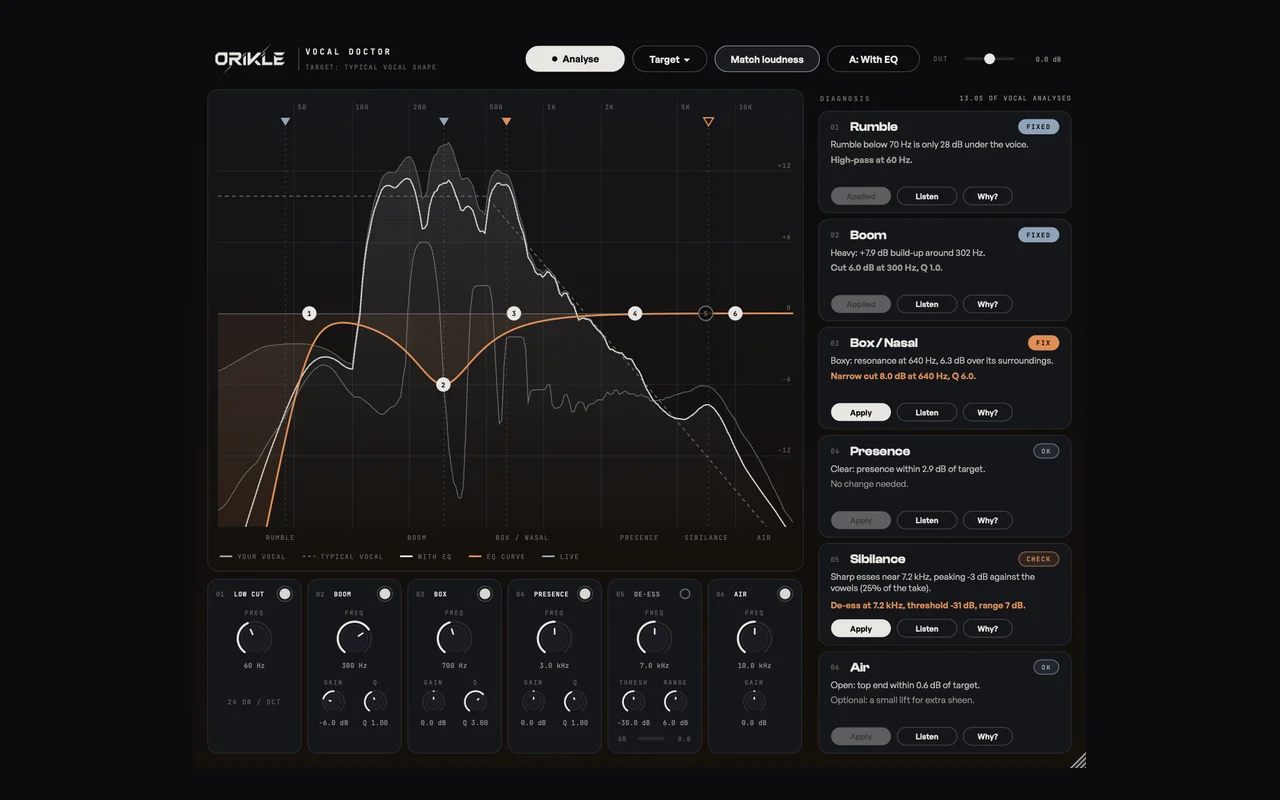
I wanted something that does the boring part (find it, measure it) so I can do the musical part (decide). The picture at the top is the diagnosis: rumble and boom already fixed, a boxy resonance at 640 Hz flagged as a FIX, the esses worth a CHECK, presence and air fine.
What it does
Press Analyse and play the take. Vocal Doctor measures the voice and lays it against a typical vocal shape. Then it writes up its notes as cards, one per problem:
- Rumble: low end under the voice that is doing nothing but eating headroom. Suggests a high-pass.
- Boom: the build-up around 200 to 400 Hz that makes a vocal sound like it is in a cupboard.
- Box / Nasal: narrow resonances in the mids, measured against their surroundings, with a narrow cut to match.
- Presence: whether the words come through.
- Sibilance: where the esses peak and how often, with a de-esser set to that frequency.
- Air: whether the top end is open or dull.
Every card carries a chip: FIX, CHECK, OK, or FIXED once you have applied it. Apply sets the EQ band for you, Listen solos just that part of the voice so you can hear the problem for yourself, and Why? explains what it measured. No black box.
The benefits
- It finds the problem in seconds, with a number on it. “Resonance at 640 Hz, 6.3 dB over its surroundings” is a decision. “Something is a bit honky” is a mood.
- Match loudness on the A/B. An EQ that adds level always sounds better. Vocal Doctor matches the loudness of before and after, so you hear the tone change and nothing else. This one habit has saved me from more bad EQ than anything else.
- You learn your own voice. After a few sessions I knew where the box resonance lives on the vocals I work with. The plugin taught my ears instead of replacing them.
- It looks like my world. Same colours, type and skull as this site, because if I am going to stare at it all night it might as well feel like home.
How I use it on a track
First on the vocal chain, before compression. Compression makes problems louder, so I want them gone before they get squeezed. I analyse a full verse and chorus, apply the FIX cards, listen to each CHECK before I decide, and leave the OK ones alone. Then compression, then space.
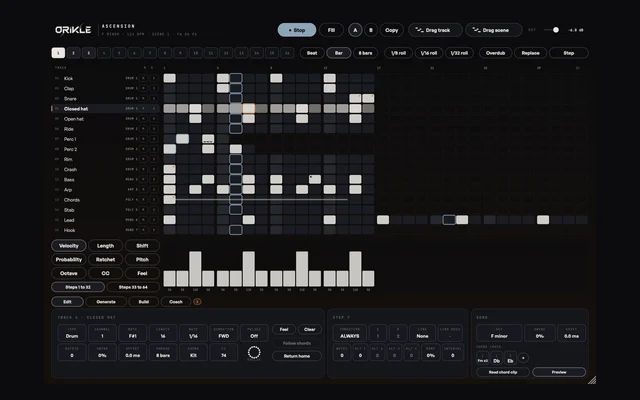
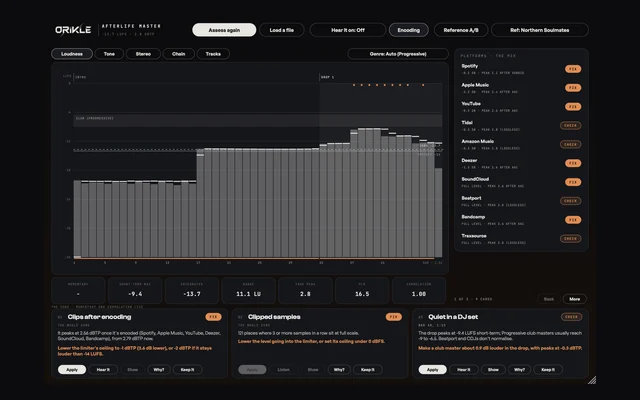
The cards idea worked so well that it became the house style. Ascension’s Coach and Afterlife Master both use the same cards, because once a plugin tells you what is wrong in plain English, going back to guessing feels like dead weight.
The honest bit
It is version 0.1, it is built for my records first, and it is a suggestion engine, not an oracle. If the doctor says cut and your ears say keep, your ears win. I put a Listen button on every card for exactly that reason.
Questions about Vocal Doctor
+ What does ORIKLE Vocal Doctor do?
It is a vocal EQ for Ableton Live that analyses a vocal, compares it with a typical vocal shape, and reports each problem as a card: rumble, boom, boxiness, presence, sibilance and air. Each card says what it found in numbers, suggests a fix, and lets you apply it, listen to just that part of the voice, or read why it matters.
+ Does it replace a mix engineer?
No. It replaces the twenty minutes of sweeping a narrow boost around trying to find the box resonance. Every fix is a suggestion with the numbers on it, and you decide whether to keep it.
+ Can I buy Vocal Doctor?
Not yet. I built it for my own records. If you want to know more or try it, DM the word DOCTOR to @orikle_music on Instagram.
+ Which formats and systems does it run on?
AU and VST3 on macOS 12 or later, as a universal build for Apple Silicon and Intel Macs. It is built for Ableton Live and goes first on the vocal chain, before any compression.