Plugins / Instrument (drop impact) ·
Six Feet Under: a drop impact plugin that builds the whole cinematic drop from one MIDI note
One MIDI note gives me the roll, the impact, the sub that dives onto my key and the tail, all locked to tempo and set in bars. Pure synthesis, no samples. Here is why I built it, and why version one sounded like fuzz.
- Plugin
- ORIKLE Six Feet Under
- Type
- Instrument (drop impact)
- Formats
- AU, VST3, Mac
- Version
- 0.2
The drop is the moment the whole track has been promising. Eight or sixteen bars of build, the room holds its breath, and then the floor opens. If that moment is a stock sample everybody else also owns, the promise is broken.
Six Feet Under puts the drop six feet under, where it belongs.
Why I built it
I wanted the cinematic drop: a roll of thumps speeding up, a weighty hit exactly on the bar line, a sub that dives onto the key of the track, then a tail. The kind of thing you hear in a trailer and in the big melodic sets.
Doing that by hand means four or five tracks: a sampled roll you have to time-stretch, an impact, an 808 with a pitch envelope you tune by ear, a reverb send, automation for all of it. Change the tempo and it all falls apart. Change the key and you are re-tuning the sub at 2am.
I wanted one note to do the lot.
What it does
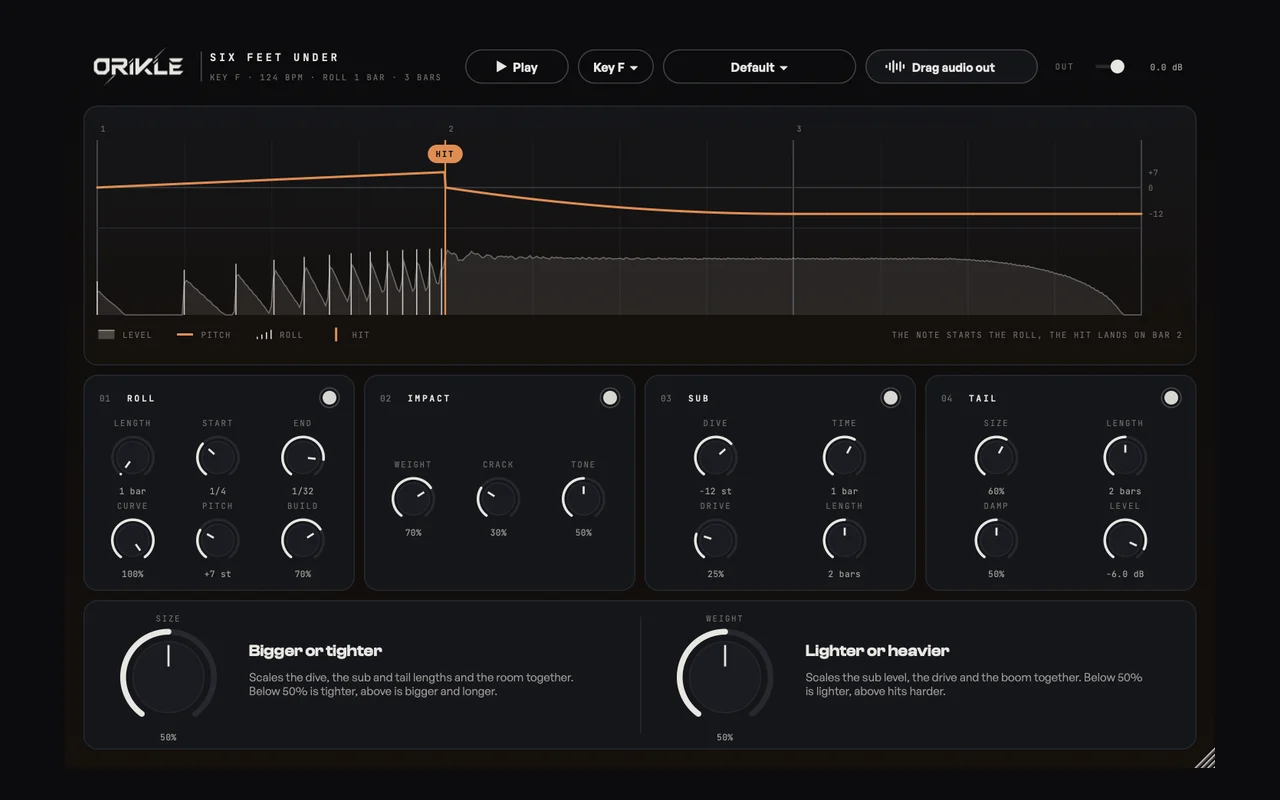
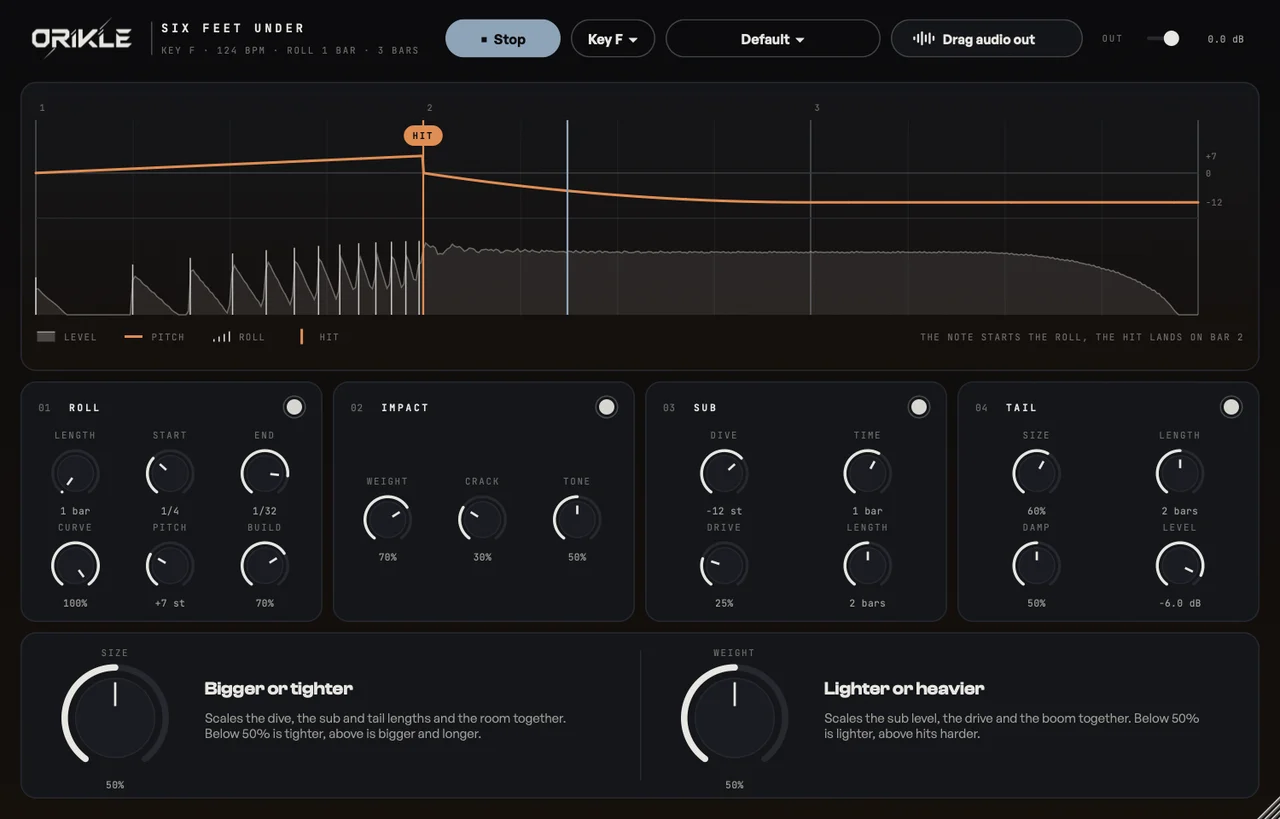
Draw one note where the roll should start. The hit lands on the bar line after the roll, and the note’s pitch sets the key. Then shape four layers, each with its own power switch:
- Roll: 1, 2 or 4 bars, start and end rate (down to 1/64), a curve that holds back then rushes in, pitch rise and volume build.
- Impact: a falling thump, a low-mid body and a bright crack.
- Sub: how far above your key it starts, how long it takes to dive, drive for warmth on small speakers.
- Tail: a reverb on the hit, with size, length and damping.
Two big macros sit underneath. Size makes the whole thing bigger or tighter. Weight makes it lighter or heavier. Presets cover cinematic trailer, festival EDM, dark techno and Ibiza melodic house.
Then Drag audio out renders it at the project tempo as a 24-bit WAV, sample for sample what you heard.
The grave mistake in version one
Honesty time. Version 0.1 measured beautifully in every test I wrote. Timing perfect, tuning perfect, levels perfect. And it sounded like fuzz.
When I finally looked at where the energy was, 70 to 90% of the drop sat below 30 Hz. Most speakers cannot play that, so what you actually heard was the distortion on top. I had built a very precise way of making speakers cry.
Version 0.2 rebuilt the sound from the ground up. Now the energy under 30 Hz is at least 20 dB below the loudest band in every preset, every hit has a real low-mid body and an audible crack, and every roll sits above 60 Hz. The lesson changed how I build everything: test the sound, not just the numbers. Every ORIKLE plugin that makes sound now gets checked band by band and rendered for my ears before it ships.
The benefits
- One note, whole drop. No sample hunting, no time-stretching, no tuning.
- Always in key. The sub lands on your key within a cent, whatever octave you played.
- Always in time. The hit lands on the exact sample of the bar line at 90, 124 or 174 BPM.
- Translates to small speakers. The rebuilt sound has body and crack, so the drop still reads on a phone.
- Safe. A limiter keeps it under 0 dBFS so it never wrecks the master.
How I use it on a track
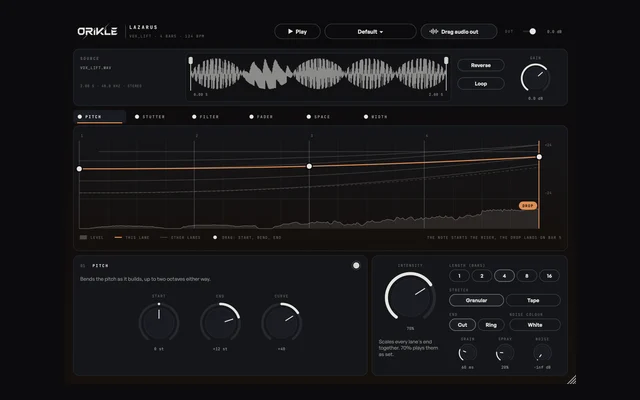
One note a bar before the drop, a 1 bar roll, the Ibiza or dark techno preset as a start, Weight up a touch. When it is right I drag the audio out and commit it, so I can EQ it with the rest of the track. Pair it with Lazarus for the riser before it, and the build and the drop are both yours. Smoke me a kipper, I’ll be back for the drop.
The honest bit
It is a drop, not a kick. It is not trying to replace your drums. And the sound is measured to be balanced, but taste is taste: if it is not your flavour of boom, the Weight and Size knobs are there for you to dig your own grave.
Questions about Six Feet Under
+ What does ORIKLE Six Feet Under do?
It synthesises a complete drop moment from a single MIDI note: an accelerating roll of tuned thumps, an impact on the bar line, a sub that dives in pitch onto the key you played, and a reverb tail. Everything is set in bars and locked to the project tempo, and the result can be dragged out as a 24-bit WAV.
+ How does it know what key my track is in?
The note you draw sets it. Draw any F for a track in F minor, in any octave, and the sub always lands on F in the sub octave, within a cent.
+ Will it clip my master?
No. At default settings it peaks around -4 dBFS, and a safety limiter keeps every preset under 0 dBFS even at full weight and +6 dB out.
+ Can I buy Six Feet Under?
Not yet. I built it for my own records. DM the word SIXFEET to @orikle_music on Instagram if you want to know more or try it.